Getting around Strasbourg: tram, tickets, walking
Station to cathedral, what a ticket costs, and the honest answer to whether you need the tram at all in a city you cross on foot in twenty minutes.
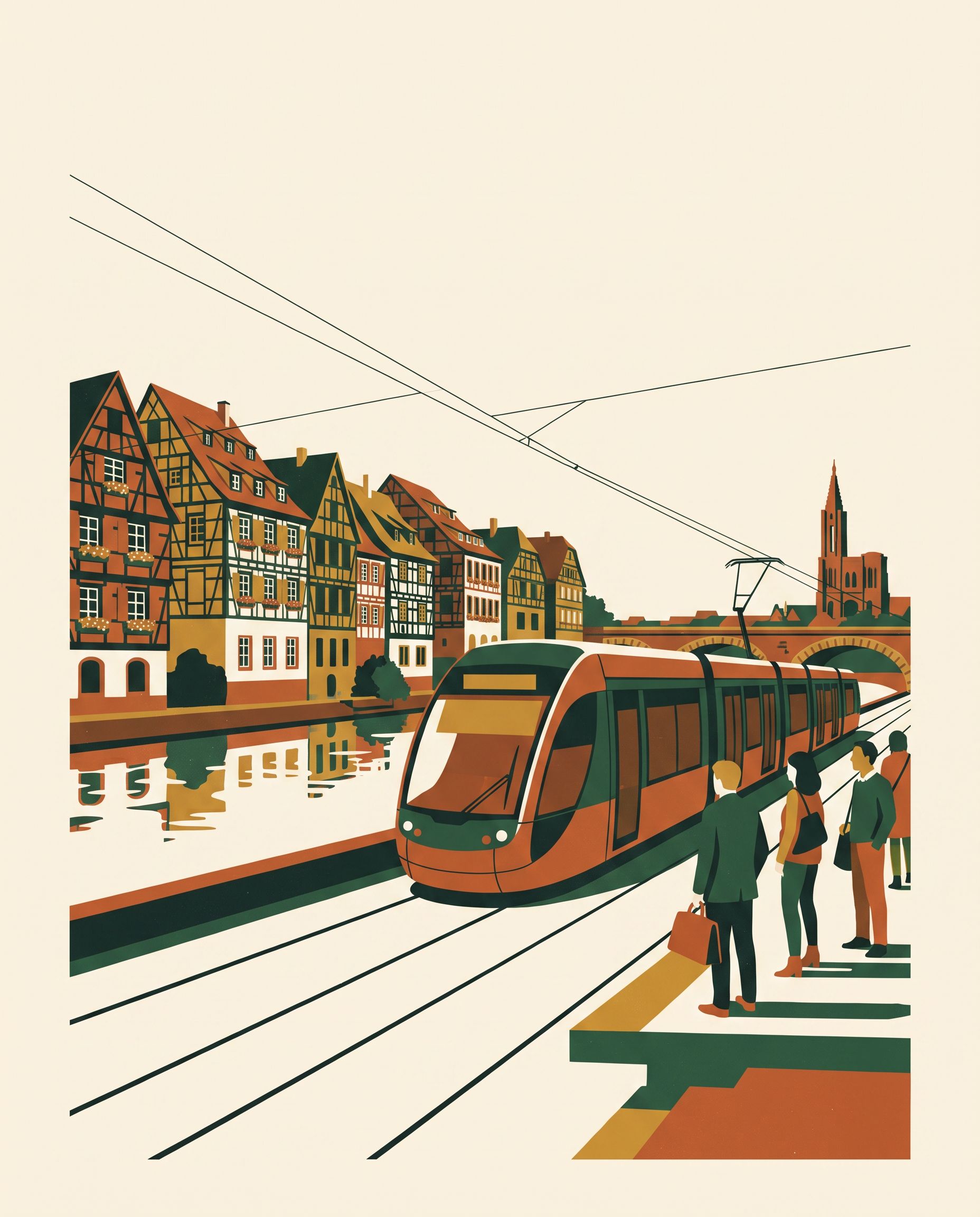
Here is the short version, because that is all most visitors need. You will walk almost everywhere in Strasbourg. The tram is excellent, and you will use it about three times in a weekend.
This page covers the three things worth knowing before you arrive: how to get from the station to the centre, what a ticket costs, and when the tram actually beats your feet.

Station to the centre, the one journey you really need
Strasbourg's main station is inside the city, not beside it. Place Kléber is about 1.2 km (0.75 miles) away, and the cathedral a couple of minutes beyond that.
On foot, allow twelve to fifteen minutes straight down rue du Maire-Kuss and over the river. There is not a metre of gradient, and you enter the Grande Île from the right side. This is the default we recommend.
By tram, lines A and D leave from the underground Gare Centrale station directly beneath the forecourt. Four minutes to Homme de Fer, then two minutes on foot to Place Kléber. Worth it with luggage or in the rain, and not otherwise.
What a ticket costs
A single bought in the CTS app costs €1.90 and is valid for one hour across the whole network, changes included. Bought from the driver on board it costs noticeably more, so download the app before you land.
There are also day passes: a 24-hour pass for one person, a 24-hour pass covering one to three people travelling together, and a 72-hour version for a long weekend. The rule of thumb is that a day pass pays for itself on the third journey of the day, and most visitors never make three.
The Europass 24h is the one to know if you are crossing into Germany for more than a tram ride: it covers the Strasbourg network and the Ortenau on the German side, buses and regional trains included.
And the best value on the whole network is not a tram ticket at all. It is the park and ride at €4.20 a day, which includes unlimited tram and bus travel for everyone in the car, up to seven people. That, and where the sites are, is covered in do you need a car in Alsace.
The six lines, briefly
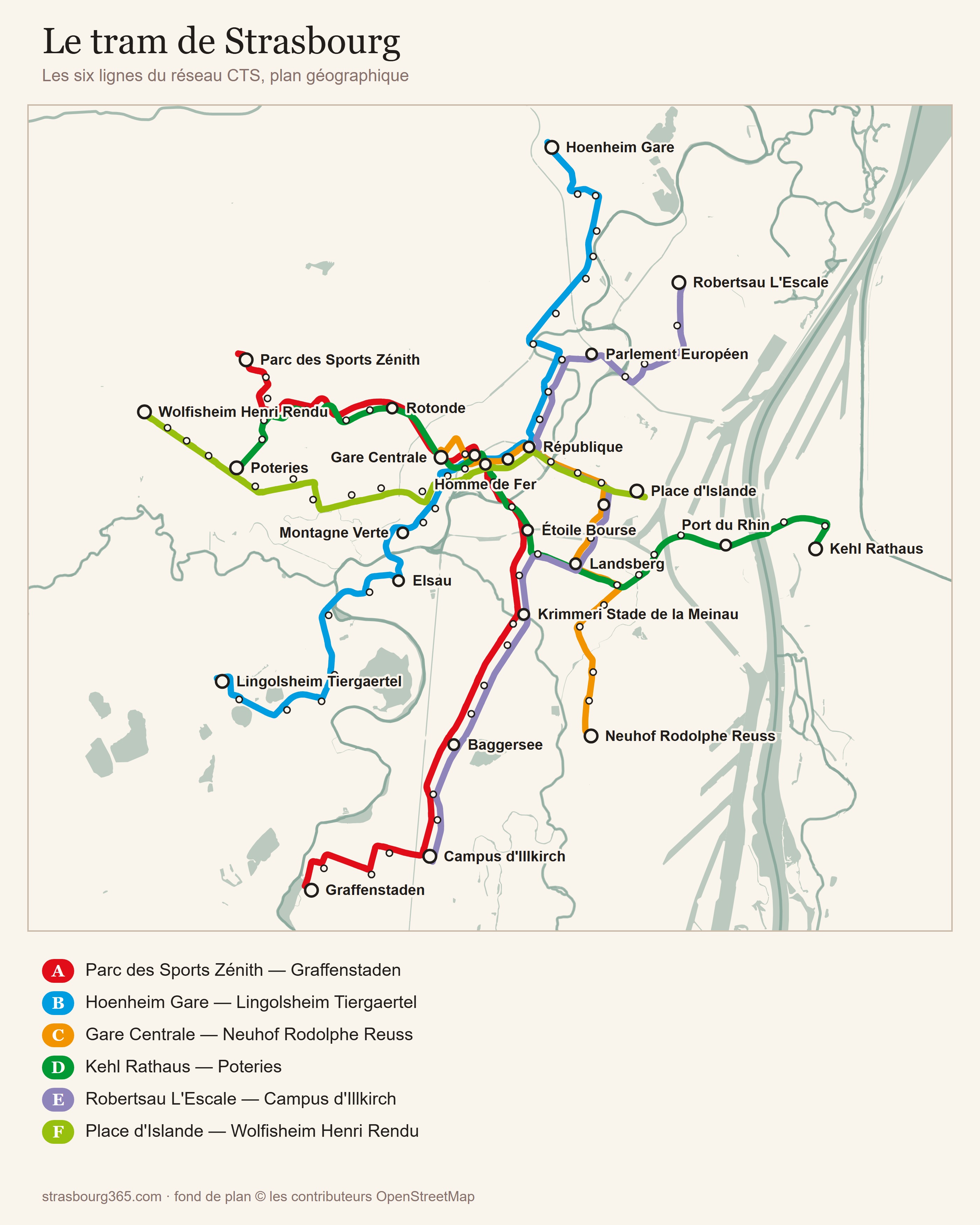
Tap the map to open it full size, in the official CTS colours. Base map © OpenStreetMap contributors.
Download the tram map (JPG, 800 KB) ↓
A and B are the two long axes, north to south and north east to south west. C runs from the main station out to the Neuhof. D crosses the Rhine into Germany. E is the one visitors actually use, for the European quarter and the Orangerie. F covers the west.
The network is meshed, so several lines share the central section: between Homme de Fer and République a tram comes every two or three minutes even when each individual line runs quarter-hourly. Homme de Fer is the hub, three minutes' walk from Place Kléber, and it is where you change and where you get your bearings.
The stops worth knowing
- Langstross Grand'Rue (A and D): the closest to the cathedral, five minutes on foot.
- Homme de Fer: Place Kléber, and the interchange between five lines.
- Gare Centrale (A, C, D, F): under the glass shell, where the fast trains and the airport shuttle arrive.
- Musée d'Art Moderne: the southern way into La Petite France and the Ponts Couverts.
- Parlement Européen (line E): the institutions, fifteen minutes from the centre.
Frequencies, late trams and night buses

During the day, expect a tram every five to eight minutes on the main lines, and less often in the evening and on Sunday mornings. Trams and buses run into the late evening, after which the Hibus night network takes over on Thursday, Friday and Saturday nights, which is exactly when evenings in the Krutenau run long.
One word of honesty about timetables. First and last departures vary by line and by stop, and the timetables change several times a year. The CTS app and the boards at the stops are the only sources accurate to the minute, and we do not copy out times that would be wrong in three months.
Taking the tram to Germany
Line D crosses the Rhine and stops at Kehl Rathaus, in the middle of the small German town on the other bank. It is 24 minutes from Homme de Fer and 28 minutes from the main station, with a tram every 13 to 16 minutes during the day.
A 24-hour pass covers line D as far as Kehl. To go further into the Ortenau, on German buses or trains, you need the Europass. For the price of a tram ticket it is a complete change of country, and it is the cheapest half day out in this guide.
Do you actually need the tram?
A fair question, and the honest answer is: not much. The historic centre is crossed on foot in twenty minutes, and the Grande Île is not served from the inside at all. The tram goes round it.
In practice there are three uses. Getting into the centre from the station or a park and ride, going up to the European quarter and the Orangerie on line E, and getting home in the evening without walking. For everything else, walking is faster than waiting, and our map of the quarters and walking times shows why.
The right reflex in one sentence
Walk by default, buy a single in the app when your feet give up, take line E for the European quarter, and if you have arrived by car, leave it in a park and ride and never think about it again.
Sources: CTS (occasional ticket range, network composition and Hibus night service), strasbourg.eu, network data as of November 2025. Fares and works change: this page is updated at each change.
Frequently asked questions
How much is a tram ticket in Strasbourg?
How do I get from Strasbourg station to the city centre?
Do I need to buy a travel pass for a weekend in Strasbourg?
Can you take the tram from Strasbourg to Germany?
Does the tram run at night in Strasbourg?

Margot Keller
A Strasbourgeoise by choice for fifteen years, Margot looks after the practical pages and the Christmas market file. Every year she walks the markets from opening day, to tell the honest mulled wine from the tourist trap.