Christkindelsmärik, Place Broglie: the 1570 Market
What the impossible name means, who the Christkindel actually is, what the 65 chalets on Broglie really sell, and what a stall costs the person running it.
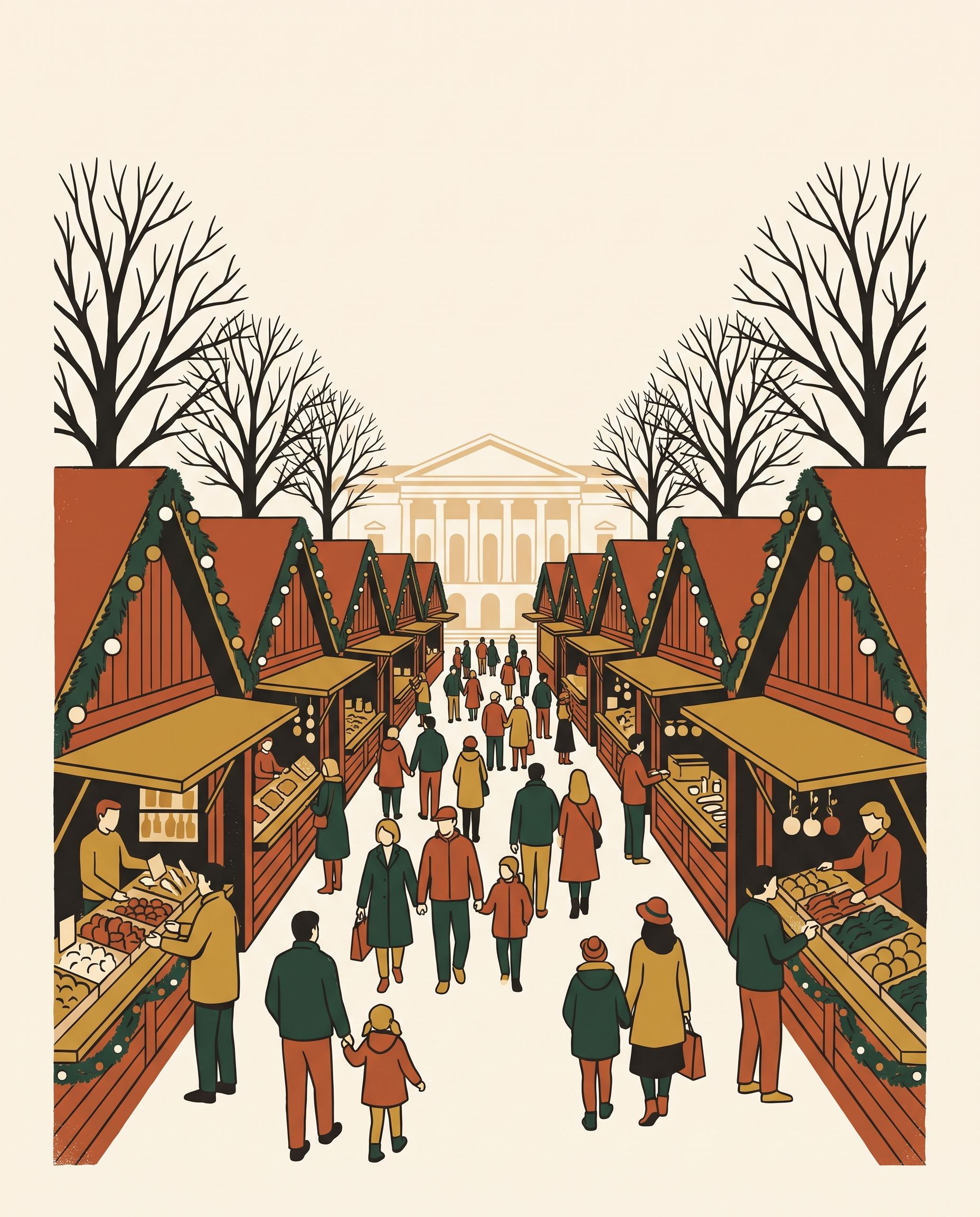
This is the market everybody walks through and almost nobody can spell. On Place Broglie stands the Christkindelsmärik, the original core of Strasbourg's Christmas: it has been here since 1570, it has the most chalets, and it concentrates both the historical legitimacy of the event and the criticism aimed at it.
This page is not the history of the market as a whole, which is elsewhere on the site. It explains the word, the figure behind it, what is actually sold on the chalets of Broglie, what a stall costs its holder, and what this square is for the other eleven months of the year.
What the word means, and how to say it
The reference spelling, the one used by the city of Strasbourg and its official communications, is Christkindelsmärik. The word is Alsatian, a Low Alemannic dialect close to the German spoken over the Rhine, and it breaks into three pieces.
- Christkindel: the dialect form of the German Christkind, the Christ Child.
- -s-: the genitive marker, our word "of".
- Märik: the Alsatian form of Markt, market.
Literally, then: the Christ Child's market. Out loud, roughly krist-KIN-del-SMAY-rik, with the stress on the second syllable. A German speaker reads it at first glance; an English or French speaker does not.
Several variants circulate and they are not all equal. Chrìstkìndelsmärik, the accented dialect spelling, was used by the city's own site in 2023; Christkindelsmarik without the umlaut is a simplification common in guidebooks and translations. The forms "Christkindelsmärk" and "Christkindelsmärick", which you sometimes see, match no attested spelling at all.
Who the Christkindel is, and why she is not Father Christmas
The Christkindel is not an old man in red. In the Alsatian tradition she is a young veiled woman dressed entirely in white, wearing a crown of fir branches set with four candles, carrying a staff topped with a star and a basket of bredele biscuits, sweets and tangerines.
Folklorists place her alongside the white ladies of Germanic legend and the Scandinavian Saint Lucy.
Her creation was a political act. In 1570, in a Strasbourg that had turned Protestant, the city abolished the Saint Nicholas fair: giving presents in the name of a saint smelt of popery. The market was allowed to continue under new patronage, that of the Christ Child.
The Christkindel is therefore an invention of the Reformation, a way of keeping the festival and changing who it was dedicated to. Until the end of the nineteenth century it was she, not Saint Nicholas, who brought presents in Alsace. Then the traditions blurred, and Father Christmas, a secular and commercial import of the twentieth century, gradually displaced her. The name of the market is what survives of that story.
Hans Trapp, the other half of the picture
The Christkindel never comes alone. Facing her stands Hans Trapp, the Alsatian equivalent of the bogeyman who punishes: a man in dark rags, sometimes covered in straw, his face blackened, a whip in his hand. She rewards, he punishes.
The figure has a probable historical origin. Hans von Trotha, a fifteenth century lord of Berwartstein castle in the Palatinate, had a reputation for brutality and was in open conflict with the town of Wissembourg. His memory turned into a monster who had sold his soul to the devil and eaten children.
In Wissembourg the tradition is still staged during Advent: Hans Trapp questions the children and threatens to lock them up, until the Christkindel arrives to save them.
The 65 chalets: what is really on them
Of the roughly 300 chalets announced for Strasbourg, local press counted 284 for the 2025 edition and 289 for 2024, Place Broglie holds 65 on its own. It is by far the largest single site, and the only one whose layout has barely moved since it was installed here in 1870, on the old horse market.
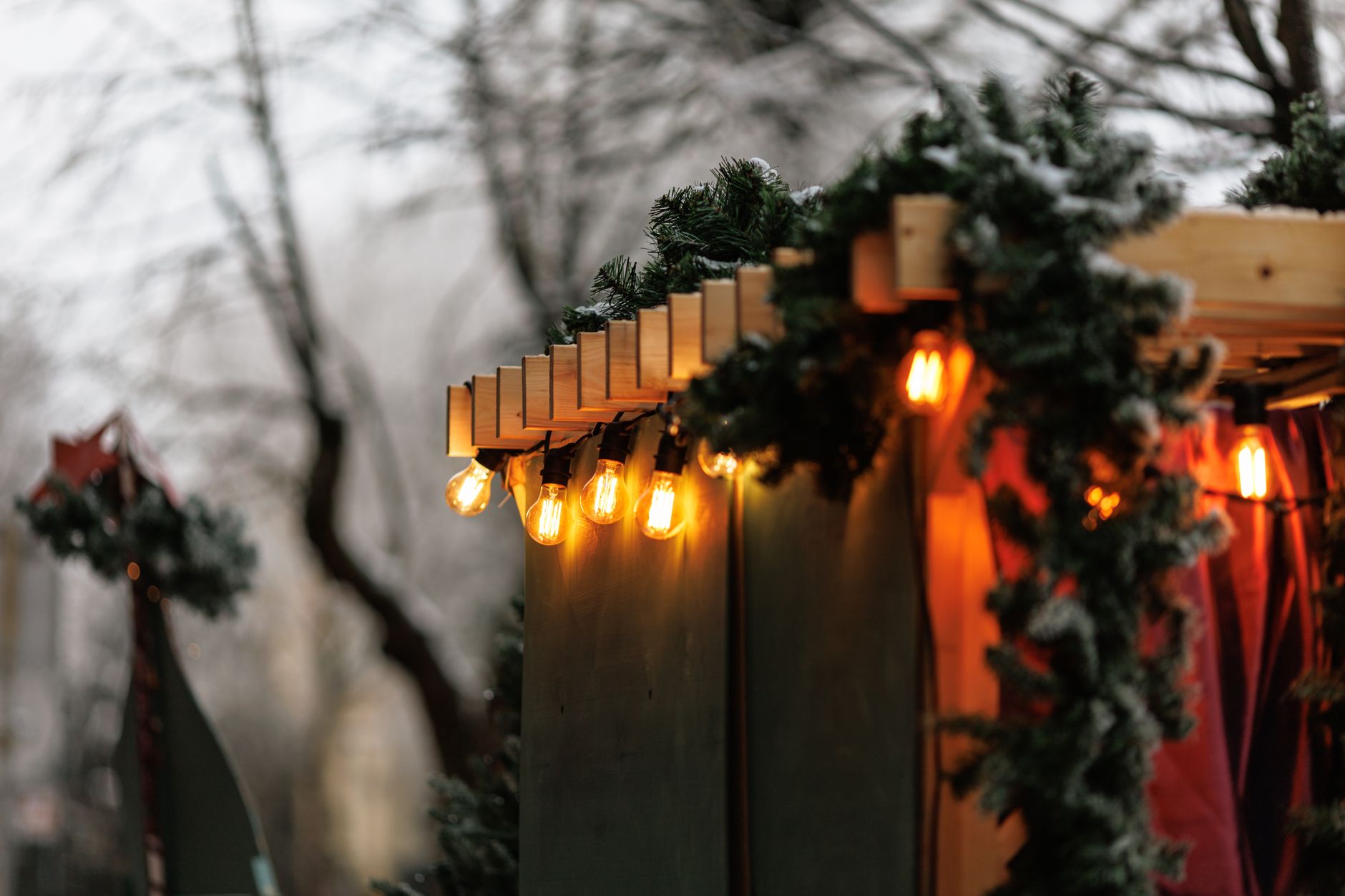
The chalets are wooden, built to a model imposed by the city, which is what gives the market its visual unity. Behind that uniform front, four very different kinds of trader sit side by side.
- Craftspeople and designers: Christmas decorations, wooden toys, ceramics, jewellery, textiles.
- Producers: winegrowers, brewers, bakers and pastry makers, meaning bredele, mannele and gingerbread.
- Takeaway food: mulled wine, tarte flambée, soups and Alsatian specialities, governed by a strict food charter. As early as 2010 a city commission banned churros and paninis as foreign to the tradition, in favour of choucroute and tarte flambée.
- Itinerant traders and showmen: confectionery, gifts, imported goods. This is the contested category, and according to the city's citizens' jury it is particularly well represented on Broglie.
That is the heart of the recurring argument about how authentic the market really is. The citizens' jury convened by the city in 2022 and 2023 recommended a specification favouring local and handmade goods. The city replied that it is legally unable to explicitly favour local products in a public tender, and chose signage and selection criteria instead.
For you as a visitor that means one practical thing: on Broglie, do not assume everything is handmade. Look at who is behind the stall and ask where the object comes from. Producers and craftspeople are there in numbers, but they stand next to resellers.
What a chalet on Place Broglie costs
This is the figure nobody publishes, and it explains a great deal about the prices you see.
Place Broglie is classified zone A, the most expensive category, along with Kléber, the cathedral square and Place du Château. Under the city's fee order, the pitch charge there rose from 108.10 euros per square metre in 2022 to 120.40 euros in 2025, for the whole run of the event. In zone B, meaning Benjamin-Zix, Saint-Thomas, Temple-Neuf and the Rohan terrace, the same square metre costs 70.40 euros.
On top come a contribution to promotion costs and one to security costs, 181.60 and 387.60 euros respectively under the 2022 schedule. Then, if the trader does not own the hut, the rental of the chalet itself: on the order of 2,200 euros before tax for 6 square metres, 2,500 for 8 and 3,700 for 12, for the duration.
Put differently, a trader renting an 8 square metre chalet in zone A has committed more than 4,000 euros before selling a single cup of mulled wine. When the prices on the market strike you as high, that is part of the reason.
How you become a stallholder
Applications are filed online with the city, with a deadline at the end of April for the following edition. Until 2023 two criteria counted: the trader's experience and the quality of their products.
Since 2024, following the citizens' jury, there are five:
- experience of the trader;
- product quality and fit with Alsatian Christmas traditions;
- environmental criteria: carbon footprint, manufacturing processes, energy use;
- inclusion and accessibility: easy-read language, wheelchair access, a vegetarian option, sliding-scale pricing;
- creativity: chalet decoration, demonstrations and live craft.
In 2024 these criteria produced only an indicative score with no effect on allocation, to prepare for strict application in 2025. Turnover stays slow: in 2025, of 300 traders assessed, seven outgoing stalls were replaced by seven new ones.
The city said at the end of 2025 that it had 150 to 160 applications waiting for a chalet, against around 80 at the start of the municipal term. Demand has doubled; the number of pitches has not.
Place Broglie the other eleven months
Without its chalets, Broglie is a long esplanade lined with lime trees, and one of the most institutional squares in Strasbourg. In the Middle Ages it was the Grosser Rossmarkt, the great horse market, which hosted knightly tournaments until the sixteenth century.
In 1740 Marshal François-Marie de Broglie, military governor of the city, turned it into a planted promenade and gave it his name.
It is bordered by the Opéra national du Rhin, built between 1804 and 1821, the prefect's residence, the eighteenth century former town hall, and the Banque de France, put up between 1925 and 1927. The square changed name with each regime: Place de l'Égalité under the Revolution, Broglieplatz, then Adolf-Hitler-Platz during the Nazi annexation, before becoming Place Broglie definitively in 1945.
It is also said to be the birthplace of La Marseillaise. A plaque on the Banque de France recalls that the house stood here in which Rouget de Lisle first sang the future national anthem, at the home of mayor Dietrich, on 26 April 1792.
The tradition is solid; the address is less so. More recent research places the composition at 126 Grand-Rue and the first performance at Dietrich's home at 17 rue des Charpentiers. The plaque preserves a symbolic memory rather than an exact location, which takes nothing away from the fact that the anthem did first ring out publicly on this square.
For the rest of the year, Broglie returns to its original purpose: a food market is held here on Wednesdays and Fridays, from early morning to the end of the afternoon. That is the best moment to see the square as it really is, between regulars and producers' stalls.
Getting there: the tram trap
The detail that ruins arrivals: during the market the Grande Île is pedestrianised from 11.30am to 9pm, and the Broglie tram stop is closed during the day, as are Langstross Grand'Rue and Alt Winmärik.
Get off at République. It is the nearest stop and the most practical if you begin your visit with the Christkindelsmärik.
Broglie is the natural starting point: from here the other eight sites string together from east to west in around thirty minutes of walking, as our map of the markets sets out square by square.
Further reading
The dates and opening hours, the hotels within walking distance, and for anyone weighing two cities, Strasbourg or Colmar.
Sources
City of Strasbourg for the market regulations, the 2022 and 2025 fee orders, the Broglie market data sheet and the trader selection criteria. Report of the Strasbourg Capitale de Noël citizens' jury (2023). DNA for chalet counts, trader turnover and waiting lists in 2024 and 2025. Actu.fr for chalet rental costs. Musée alsacien and Légendes d'Alsace for the figures of the Christkindel and Hans Trapp. Archi-wiki and Mon Grand Est for the history of the square. L'Alsace and Kuriocity for the Marseillaise plaque and its real location. Pitch fees are reassessed every year.
Frequently asked questions
What does Christkindelsmärik mean?
Who is the Christkindel?
Is the Place Broglie market the oldest one?
Is everything on Place Broglie handmade in Alsace?
Which tram stop is closest to Place Broglie?
Margot Keller
A Strasbourgeoise by choice for fifteen years, Margot looks after the practical pages and the Christmas market file. Every year she walks the markets from opening day, to tell the honest mulled wine from the tourist trap.