The Alsace Wine Route Without a Car: an Honest Guide
170 km of vineyard, seven grapes and a transport network that only half works. What you can genuinely reach from Strasbourg or Colmar, and what you cannot.
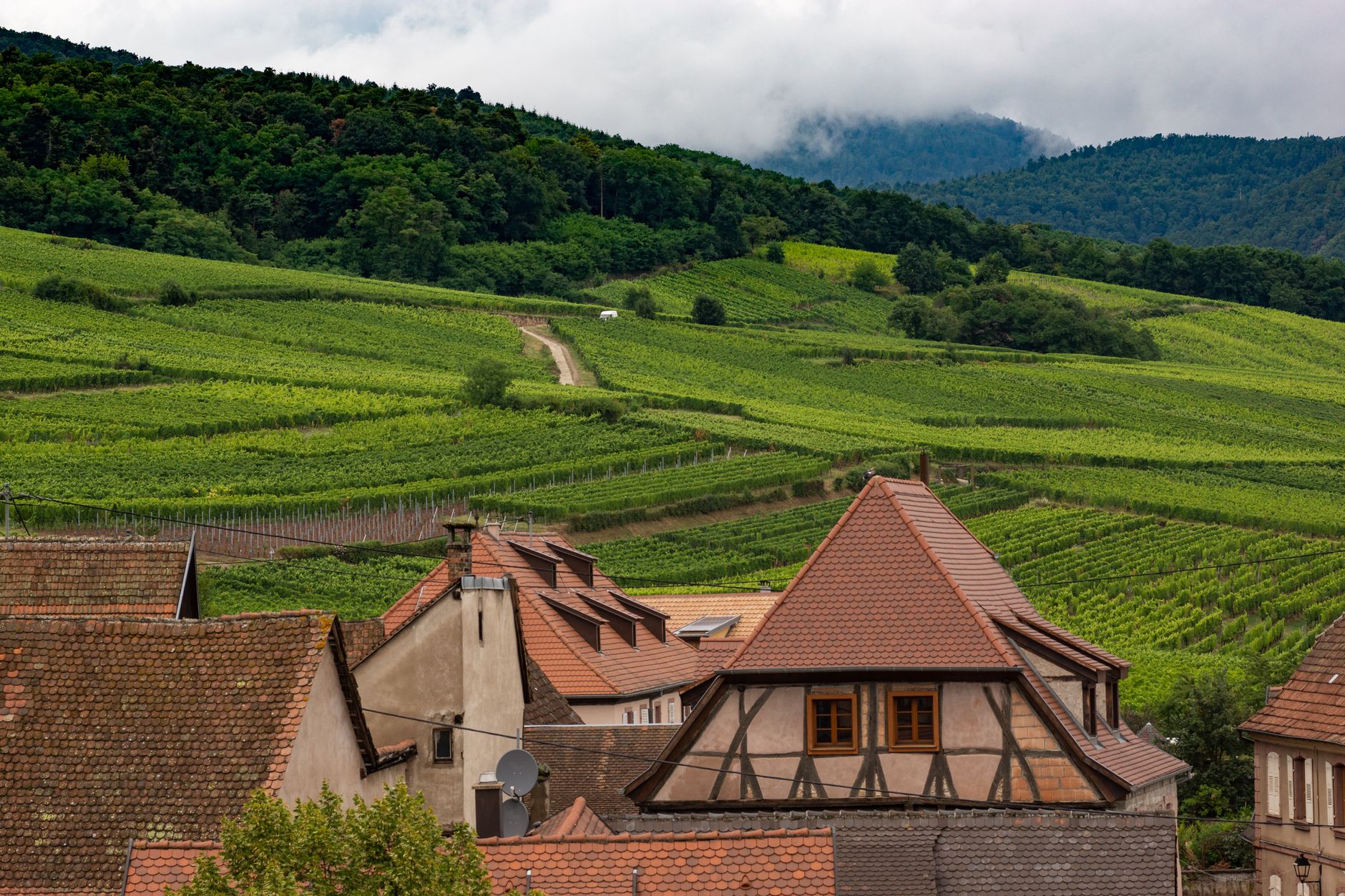
The Alsace Wine Route runs 170 km, about 106 miles, along the foot of the Vosges from Marlenheim in the north to Thann in the south. It was created in 1953, which makes it one of the oldest signposted wine roads in France, and it threads through 67 of the region's 119 wine-growing communes.
Those numbers are the easy part. The hard part, and the reason most English-language pages on this subject are useless, is that the route was designed for cars, and a large share of the people reading about it do not have one.
So this guide is organised around a single question: what can you actually reach, and what should you stop planning? We say plainly which villages have a working railway station, which depend on a rural bus, and which combinations do not fit into a day.
The seven grapes, in plain English
Alsace grows seven permitted varieties under its main appellation, and unusually for France it puts the grape name on the label rather than the village. That is the single most useful thing to know before you walk into a cellar.
- Riesling. Citrus, green apple, white flowers, and a mineral note that develops with age. In Alsace it is made dry, and it is the wine that goes with choucroute and with river fish.
- Gewurztraminer. Rose, lychee, sweet spice, exotic fruit. Intensely aromatic, and it can be dry, off-dry or sweet depending entirely on the producer. Drunk locally with munster and with strongly spiced food.
- Pinot gris. Ripe pear, quince, a little honey and smoke, with a broader texture than riesling. Often off-dry. The classic partner for creamy poultry dishes.
- Muscat. Fresh grape and flowers, crisp rather than sweet, which surprises almost every English speaker who orders it. The local pairing is Alsace asparagus in spring.
- Sylvaner. Light, herbaceous, green apple and wet stone. Dry, unshowy, and the honest everyday bottle of the region. Good with tarte flambee.
- Pinot blanc and auxerrois. Apple, pear, white flowers, a soft easy mouth. Dry to lightly off-dry, and the base of most cremant.
- Pinot noir. The only red permitted here. Cherry, strawberry, redcurrant, dry, and it runs from very light to properly structured depending on the grower.
Two misconceptions cost visitors more than any other. The first is that Alsace riesling is German riesling: it is not, the regional style is drier, tauter and built for the table. The second is that gewurztraminer is automatically sweet: it is aromatic, which is a different thing, and plenty of it is dry.
Reading the label without being caught out
Alsace has 51 grand crus, and they are delimited plots rather than a marketing word. The rules are stricter, yields are lower and the wines are more expensive. Only four grapes may carry the classification: riesling, gewurztraminer, pinot gris and muscat.
Vendanges tardives means late harvest, grapes picked well after the normal date at higher ripeness. Selection de grains nobles is the rarest tier, individually picked berries affected by noble rot. Both mentions are restricted to the same short list of grapes, and both are dessert-weight wines rather than everyday bottles.
Cremant d'Alsace is the region's traditional-method sparkling wine, mostly built on pinot blanc and auxerrois, with pinot noir behind the rose. It is one of the significant cremants in France and it is the thing most visitors underbuy.
Now the blunt part. Edelzwicker and gentil are blends, and they are made to be easy rather than instructive. They are not bad, but if you have one afternoon in a cellar and you want to understand this region, buy a single-variety bottle from a grower instead. The same goes for supermarket entry level, which is where the region's reputation for cheap sweet white came from.
The villages you can reach by train
That last clause is the problem, because the shuttle up to the castle is seasonal and not something to build a day around. Booking the Haut-Koenigsbourg castle ahead settles the ticket, but check the connection from Selestat on your own date before you commit to the train version.
This is the shortlist that actually works without a car, and it is shorter than the tourist board maps imply. Regional trains from Strasbourg serve Molsheim, Obernai, Barr, Dambach-la-Ville, Selestat, Colmar and Rouffach, all of them on or immediately beside the route, all with the station within walking distance of the old centre.
Obernai is the easiest day out of the lot from Strasbourg. Trains run from very early morning to late evening, there are dozens a day, and the shortest journey is under half an hour. The station is a short walk from the ramparts.
Selestat takes about 20 minutes at best and is the natural pivot point: it sits between the northern and southern halves of the vineyard, and it is also the railhead for the L500 shuttle up to the Haut-Koenigsbourg castle when that shuttle is running.
Colmar is 26 to 35 minutes from Strasbourg with departures every 30 minutes through the day, and it is the base from which the famous southern villages become reachable at all. Note that Colmar has no tram: everything there is done on foot from the station.
Two names that appear on wine route lists deserve a warning. Ribeauville and Guebwiller no longer have a usable passenger rail service. If a page tells you to take the train to Ribeauville, it has not checked.
The villages you cannot reach by train
Building the day backwards from the last bus is sound advice, and it is also the moment most readers decide the villages are not worth the anxiety. A guided day along the wine route does what the rural network cannot, which is several villages and a cellar with no timetable to watch, and for a car-free visitor it is usually the only version that holds together.
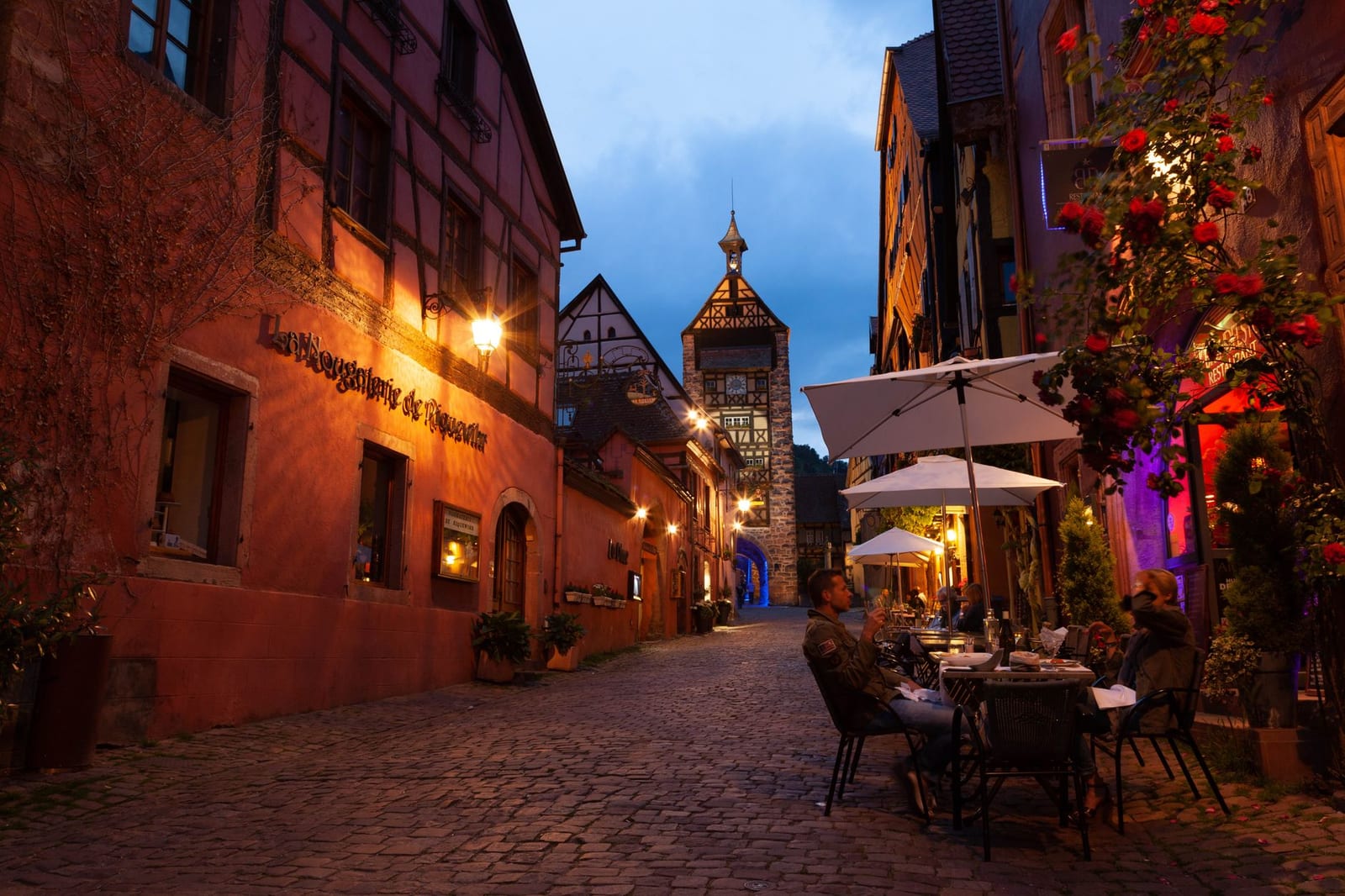
Riquewihr, Eguisheim, Kaysersberg, Hunawihr and Bergheim are the villages on the postcards, and none of them has a station. Every one of them depends on a rural coach from Colmar or Selestat, run under the regional Fluo network.
These buses exist and they do carry visitors. The Colmar tourist office points travellers without a car to the Colmar to Riquewihr to Ribeauville coach as the reference service, and the commune of Kaysersberg publishes its own bus connection from Colmar station. So the villages are not cut off.
What they are is infrequent. Depending on the line and the day you may be looking at a handful of departures rather than an hourly service, and Sunday operation is not guaranteed on every route. Line numbering has also changed between sources, so a number quoted on a blog from two years ago is not something to plan around.
Here is the honest rule. Build the day backwards from the last bus, not forwards from the first. Rural evening services thin out early, and missing the last departure from a village of eleven hundred people means a taxi you did not budget for.
And the harder truth: chaining three or four of these villages in one day on public transport does not work. Two is realistic if the timetable cooperates. One village plus a vineyard walk is the version that reliably produces a good day.
The seasonal shuttle from Colmar
Between spring and autumn there is a proper answer to this problem. The Kut'zig is an open-top hop-on hop-off coach that loops out of Colmar and calls at Ribeauville, Riquewihr, Kaysersberg, Turckheim and Eguisheim.
It runs 3 April to 11 October 2026, with a departure roughly every 1 hour 45. In April, May, June and October it operates Friday to Sunday and on public holidays; in July, August and September it runs Tuesday to Sunday.
Combined with the train from Strasbourg to Colmar, this is the one arrangement that lets a car-free visitor see several villages in a single day. It is also unashamedly a tourist bus, and in August you will be sharing it.
Two limits are worth stating. A gap of nearly two hours between departures means one missed connection removes a village from your day, so give yourself a full rotation of margin. And outside the season the shuttle simply is not there, which is why our itineraries section treats April to October as the window for this excursion at all.
In December the situation changes again: the Colmar Christmas shuttles serve Kaysersberg, Riquewihr, Ribeauville and Eguisheim, but only from Friday to Sunday, and the Eguisheim line requires booking online in advance because seats are capped.
Inside a cellar: what is free, what is booked, what is rude
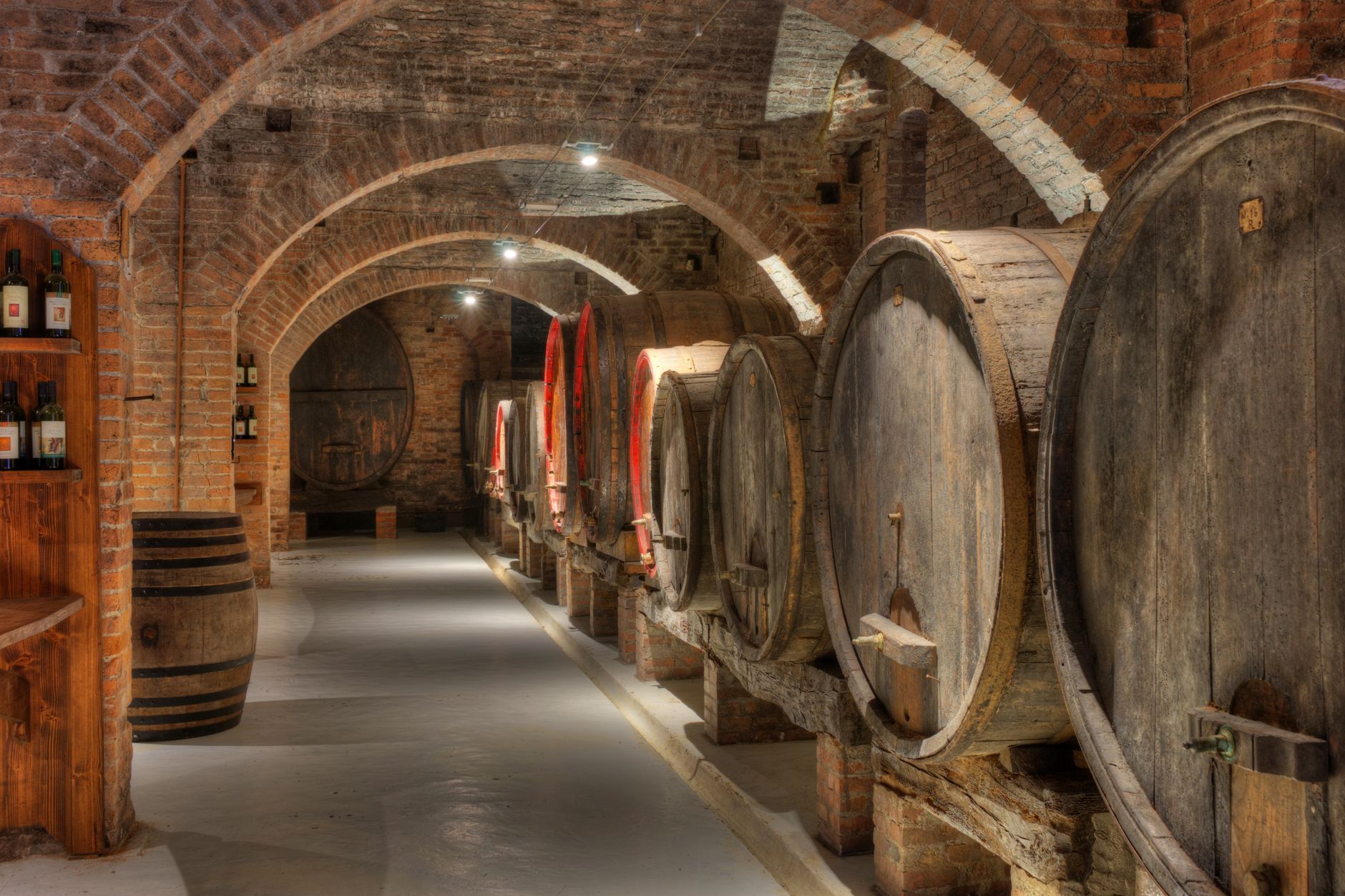
Forget what you know from Napa or Tuscany. In Alsace a great many small family estates still pour for nothing, because the tasting is a prelude to a sale rather than a ticketed experience. You walk in during opening hours, you taste four to eight wines, and you talk to the person who made them.
That generosity comes with an unwritten rule. Nobody will stop you leaving empty-handed, but after eight free glasses, taking two or three bottles is the minimum courtesy. This is a producer's shop, not a wine bar.
The large cooperatives are the reliable option if you dislike uncertainty. The cellars at Ribeauville, Turckheim and Eguisheim all keep a shop and tasting counter open to walk-in visitors through the week, and the Ribeauville cooperative also runs free guided tours of the cellar on weekday mornings and afternoons, alongside paid tasting workshops.
The famous private houses work differently. Trimbach at Ribeauville, for example, receives visitors on weekdays by appointment only, is closed on Sundays and public holidays, and shuts for the first three weeks of August and the week between Christmas and New Year. Weinbach, Zind-Humbrecht and Marcel Deiss are all reported to require booking and to charge, though we could not confirm their 2026 terms from an official source and we are not going to invent them.
So the split is simple. Walk in: village family estates on a weekday, cooperative shops, marked vineyard footpaths. Book ahead: prestige estates, commented tastings, cellar tours, food and wine pairings, and guided vineyard walks.
Two timing warnings. Harvest peaks between mid-September and the first half of October, when many estates cut their hours or receive by appointment only because everyone is in the vines. And most cellars close on 25 December and 1 January, with several also closed on 1 November and Good Friday.
Cycling it, or drinking it in Strasbourg
If you take the last suggestion seriously, and on a first trip you probably should, then what you need is a bed near the station and the wine bars rather than a room out in the vines. This one is in the station quarter, ten minutes' walk from the Grande Ile, which is the right shape for a trip built on early trains.
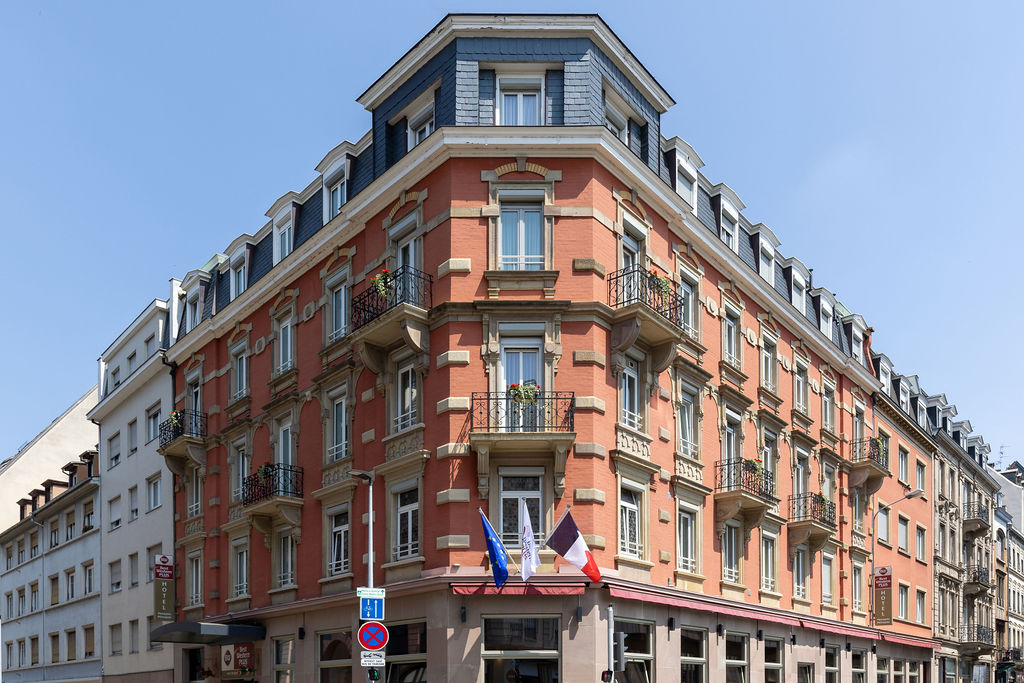
Monopole Métropole★ 4,5 · 1,317 reviews
There is a dedicated cycle route beside the wine road, the Veloroute du Vignoble, running the length of the vineyard from Marlenheim to Thann. The official wine route site gives it as 131.5 km, roughly 82 miles, while the regional cycling network quotes about 140 km, with 357 m of cumulative climb.
That climb figure matters more than the distance. This is rolling foothill country, not a flat greenway, and it suits someone who cycles regularly rather than someone hiring a bike for the first time in a decade. Done in sections between railway stations it is an excellent way to cover the vineyard without a car.
If none of this fits your trip, there is a simpler answer that nobody sells you: drink the wine in Strasbourg. The city has wine bars devoted entirely to Alsace, with well over a hundred references by the bottle and a serious list by the glass, plus independent merchants in the centre who will let you taste before buying.
For a first trip that is often the better use of a day. You cover more of the region's range in two hours in the Krutenau than in a full day of buses, and you can go to the vineyard on the next visit knowing what you like.
When to go, and taking the bottles home
Spring and early autumn are the best of it: April and May for the vines coming into leaf, September and early October for the harvest and the light. July and August are hot, crowded and the peak of the coach season.
One date reshapes the whole southern vineyard. The Foire aux Vins d'Alsace takes over the Colmar exhibition park for ten days at the turn of July and August, and it moves accommodation prices and traffic across the whole area. If you are planning a quiet vineyard week, look it up before you book.
Winter is honest about itself. Between January and early March many village estates keep short hours or close, and several of the smaller villages have very little open at all outside the Christmas period.
For British visitors, the personal allowance for bringing wine back to Great Britain is 18 litres of still wine, which is 24 standard bottles, plus 42 litres of beer, and on top of that either 4 litres of spirits above 22 per cent or 9 litres of drinks at or below 22 per cent. From 1 October 2026 the categories change: cider moves into the beer allowance and sparkling wine moves into the wine allowance rather than sitting in the lower-strength category. The litre caps for beer and still wine are not changing.
American visitors should plan around the airline rather than the customs desk: the practical constraint is checked baggage weight and packaging, not the federal allowance.
If you would rather choose villages by how easy they are to reach than by how they photograph, our guide to the most beautiful Alsace villages ranks them on exactly that. And for what to eat once you are sitting down with the bottle, start with Alsatian food.
Frequently asked questions
Can you do the Alsace Wine Route without a car?
Is Alsace riesling sweet?
Do you have to pay for wine tasting in Alsace?
Which is the better base without a car, Strasbourg or Colmar?
How much wine can I take back to the UK from Alsace?
Camille Roth
Born in Schiltigheim, Camille spent ten years working in Strasbourg kitchens before swapping the apron for a notebook. She writes about winstubs, the city's newer tables and Alsatian produce. Her rule: never recommend an address she would not send her own parents to.