Strasbourg Christmas Market: Accessibility
Free wheelchair loan, a signed accessible route, priority lanes and adapted tours. The scheme is real and serious. So are the cobbles, the cables and the crowd.
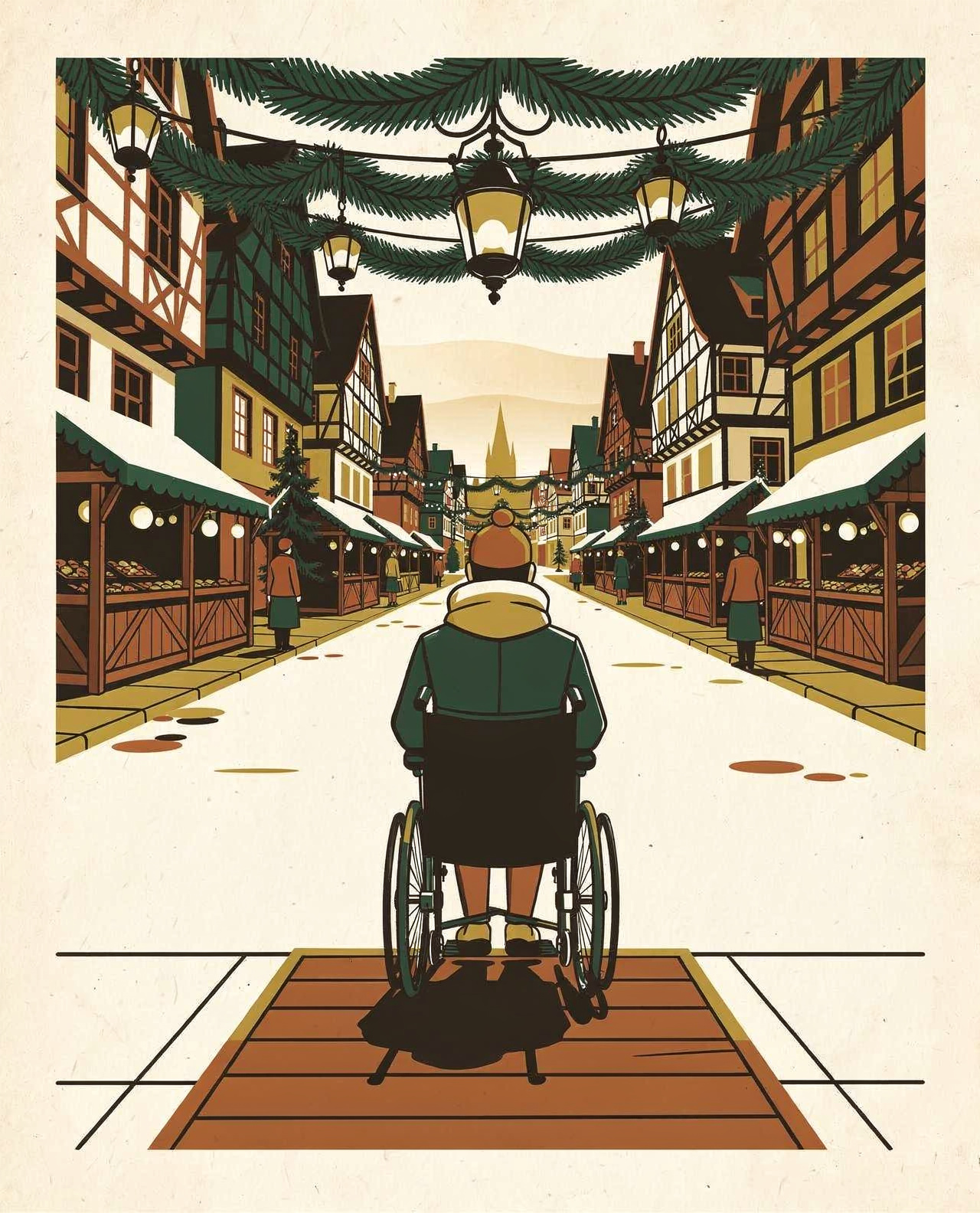
Most pages about accessibility at the Strasbourg Christmas market simply reprint the city's press release. The scheme looks impeccable there, and it has genuinely grown in recent years.
Except that in December 2025, several local outlets went on site with visitors using wheelchairs and with sight loss. One headline summed it up in three words: an obstacle course.
Both realities coexist, so here are both: what the city provides, and what still gets in the way, so you can decide with your eyes open and prepare accordingly.
What the city provides
Free equipment loan on Place Kléber
This is the most useful part of the scheme and the least known. The information chalet on Place Kléber lends wheelchairs and walking frames free of charge, against a piece of identification left as a deposit.
The loan hours are shorter than the market's: 11.30am to 6.30pm, while the chalets stay open until 9pm. Build the return of the equipment into your plan, or you will find yourself hurrying at 6.15pm.
Stock is limited and loans depend on availability. On a Tuesday in early December you will have a choice. On a Saturday afternoon on 20 December, much less so.
The accessible route and the signed circuits
The city publishes a dedicated market map, designed with local disability associations, which sets out a recommended route for disabled visitors.
Signed circuits link the different markets while avoiding the hardest points, and are described as suitable for pushchairs as well as wheelchairs. Every bridge onto the Grande Île stays open to pedestrians.
Pick the map up at the information chalet when you arrive. It does not replace scouting the ground yourself, but it saves you the most punishing dead ends.
Priority lanes and quiet zones
The 2025 edition introduced two things that concretely change a visit.
First, priority lanes for disabled visitors, notably at the entry points to the perimeter, where the security checks create the longest waits.
Second, quiet zones, equipped with ear defenders, blankets and stress balls. The city team described them as "a small moment of breathing space in this Christmas marathon". For an autistic visitor, a hypersensitive one, or simply someone worn out by the noise, that is a long way from a gimmick.
The quiet zone at the Aubette, on Place Kléber, also serves families: changing tables, bottle warmers, seating.
Adapted guided tours
Every Tuesday in December, a guide-lecturer runs a free adapted tour. The choice of Tuesday is not accidental: along with Monday, it is the least busy day of the whole season.
The chalet counters
A point often ignored and yet decisive: since the 2024 edition, most chalet counters have been lowered to a height reachable from a wheelchair.
It is a real improvement, confirmed on the ground by the visitors concerned. It is not universal: some stalls, particularly the older or more improvised ones, remain out of reach.
What still gets in the way
The accounts gathered by the local press in December 2025 are specific, and they are all about the ground and the crowd.
The cables and the raised crossings
This is the number one obstacle cited by manual wheelchair users: the many raised humps covering the power cables running to the chalets. They are everywhere, they are high, and they are hard to cross without help.
In a powered chair the nuisance is real but manageable. In a manual chair, alone, several of these crossings need someone else's hands.
The cobbles
The Grande Île is a listed historic centre, with everything that implies about old surfaces. The approaches to the cathedral are particularly punishing, with uneven cobbles that shake you seriously.
That is not an organisational failing, it is the city itself. No seasonal scheme will correct it.
Damp and ice
December in Strasbourg means an average of 14 days of frost and around ten days of rain. Very slippery patches have been reported on Place Kléber in previous editions.
Wet ground on smooth cobbles, in a chair or with a stick, demands constant attention.
The crowd, and how the crowd behaves
This is the point that comes up most often, and the hardest for any scheme to fix. "The most annoying thing is people's rudeness: one person in two does not move aside when they see a wheelchair," summarised one visitor interviewed on site.
With 3.4 million visitors across the 2024 edition, the density at peak hours makes some routes simply impassable.
The particular case of sight loss
A point rarely raised: for a visitor with low vision, the Christmas market stacks the difficulties. The intense brightness of the stalls, the violent contrast between lit and dark zones, and the moving crowd combine to make orientation very hard.
One visitor with optic neuropathy was unambiguous: the market is a difficult environment, one that forces you to be accompanied where you would be independent elsewhere in the city.
Getting there and getting around
The tram, still Strasbourg's biggest asset
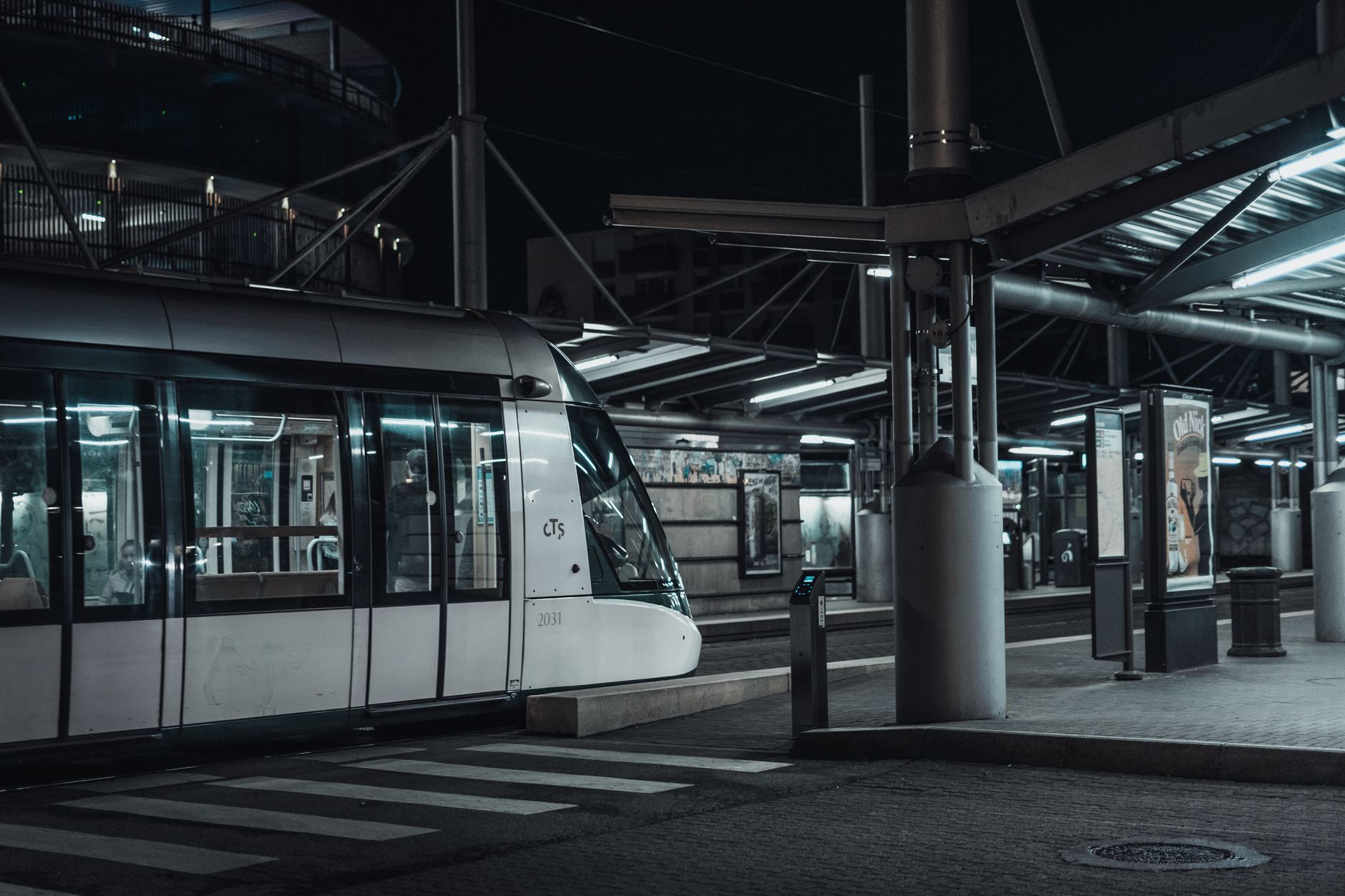
The entire CTS bus and tram network is wheelchair accessible, with ramps at the stops and low floors throughout. It is one of the city's objective strengths, and it matters a great deal if you are arriving by train or by plane rather than by car.
But watch the seasonal trap: three central stops close during the day throughout the market, Broglie, Langstross Grand'Rue and Alt Winmärik.
The good news is that Homme-de-Fer stays open, and it is precisely the most useful one: it puts you two minutes from Place Kléber, and therefore from the information chalet and the equipment loan.
MobiStras
Since 2011 the metropolitan authority has run MobiStras, a door-to-door transport service for people with reduced mobility across the whole conurbation, at a flat fare of €1.70.
It is the option to know about if the journey from your accommodation is a problem, particularly in the evening when tiredness compounds the cold. Bookings are made in advance and December slots go quickly.
Cars and parking
The Grande Île is pedestrian 11.30am to 9pm and on-street parking is banned there day and night, so the question does not arise inside the perimeter.
The system to aim for is the park and ride at €4.20 a day, which includes unlimited tram and bus travel for everyone in the vehicle. Ask CTS in advance about the reserved bays at the site you are targeting, as the number varies from one to another.
Do you need a disability card?
Not for the market itself. Entry is free for everyone, there is no ticket, and therefore no concession to prove.
The equipment loan only asks for a piece of identification left as a deposit, and the adapted tours are free. Bring your card anyway if you have one: identity checks are carried out at random inside the security perimeter, and it helps if you want to use a priority lane.
Our visit plan, if we were doing it again
From everything above, one conclusion stands out: the factor that weighs most is not the scheme, it is when you come.
The city's crowding table rates Monday and Tuesday light across every slot of the day. Saturday between 1pm and 9pm is the worst moment of the week, and the two weekends before Christmas are the worst of the season.
The programme we would follow:
- A Tuesday in early December, between the 1st and the 15th. It is also the day of the adapted tours.
- Arrive around midday, as the chalets open, while the perimeter still flows.
- Tram to Homme-de-Fer, then the information chalet on Place Kléber for the accessible map and, if needed, the equipment loan.
- Kléber and Broglie first, the most open squares, before the afternoon influx.
- A break in a quiet zone before moving on to the cathedral, the hardest part for cobbles.
- Stay until 4.30pm or 5pm for the illuminations coming on, the best moment of the day, then return the equipment before 6.30pm.
That plan takes five hours and covers the essentials without ever meeting the crush.
Where to stay to keep the journeys short
The criterion to prioritise is not the view but the distance to an accessible tram stop, and the absence of steps at the hotel entrance.
Recent buildings in the inner suburbs are often far better equipped than the charming hotels of the historic centre, which sit in old buildings where the lift, when there is one, is tiny. Two that come up for this reason are the Hilton Strasbourg in the European quarter, a modern building with wide lifts and good tram links, and the Monopole Métropole opposite the station, with step-free access.
Call before booking, and ask three questions: steps at the entrance, the width of the bedroom door, and walk-in shower or bath.
Is it worth going?
Yes, with preparation. The Strasbourg Christmas market is not an easy destination in a wheelchair, and pretending otherwise would serve nobody.
But a Tuesday at midday in early December and a Saturday at 5pm on 20 December are not the same outing. They are not even the same place.
To plan the rest: the smaller and quieter markets, where to eat during the market, and the full Christmas section.
Sources: City of Strasbourg and the official Strasbourg Capitale de Noël site (equipment loan at the information chalet, signed circuits, accessible map, adapted tours, quiet zones, priority lanes, crowding table); Rue89 Strasbourg, December 2025, on the inclusivity measures of that edition and the figure of 3.4 million visitors in 2024; Pokaa and France 3 Grand Est, December 2025, for the accounts of wheelchair users and visitors with sight loss; CTS and MobiStras (network accessibility, adapted transport at €1.70); Météo-France, 1991 to 2020 normals for the Strasbourg-Entzheim station. The measures are renewed and adjusted each year: check the detail of the current edition with the city.
Frequently asked questions
Is the Strasbourg Christmas market wheelchair accessible?
Where can I borrow a wheelchair at the Strasbourg Christmas market?
Which tram stop should I use in a wheelchair during the market?
Is there an adapted transport service in Strasbourg?
When is the best time to visit the market with a disability?
Is the Christmas market suitable for visitors with sight loss?
Margot Keller
A Strasbourgeoise by choice for fifteen years, Margot looks after the practical pages and the Christmas market file. Every year she walks the markets from opening day, to tell the honest mulled wine from the tourist trap.