The Most Beautiful Alsace Villages, Ranked by Access
Riquewihr, Eguisheim, Kaysersberg, Ribeauville and the quiet ones. Which hold the national label, which are film sets in August, which you can reach.
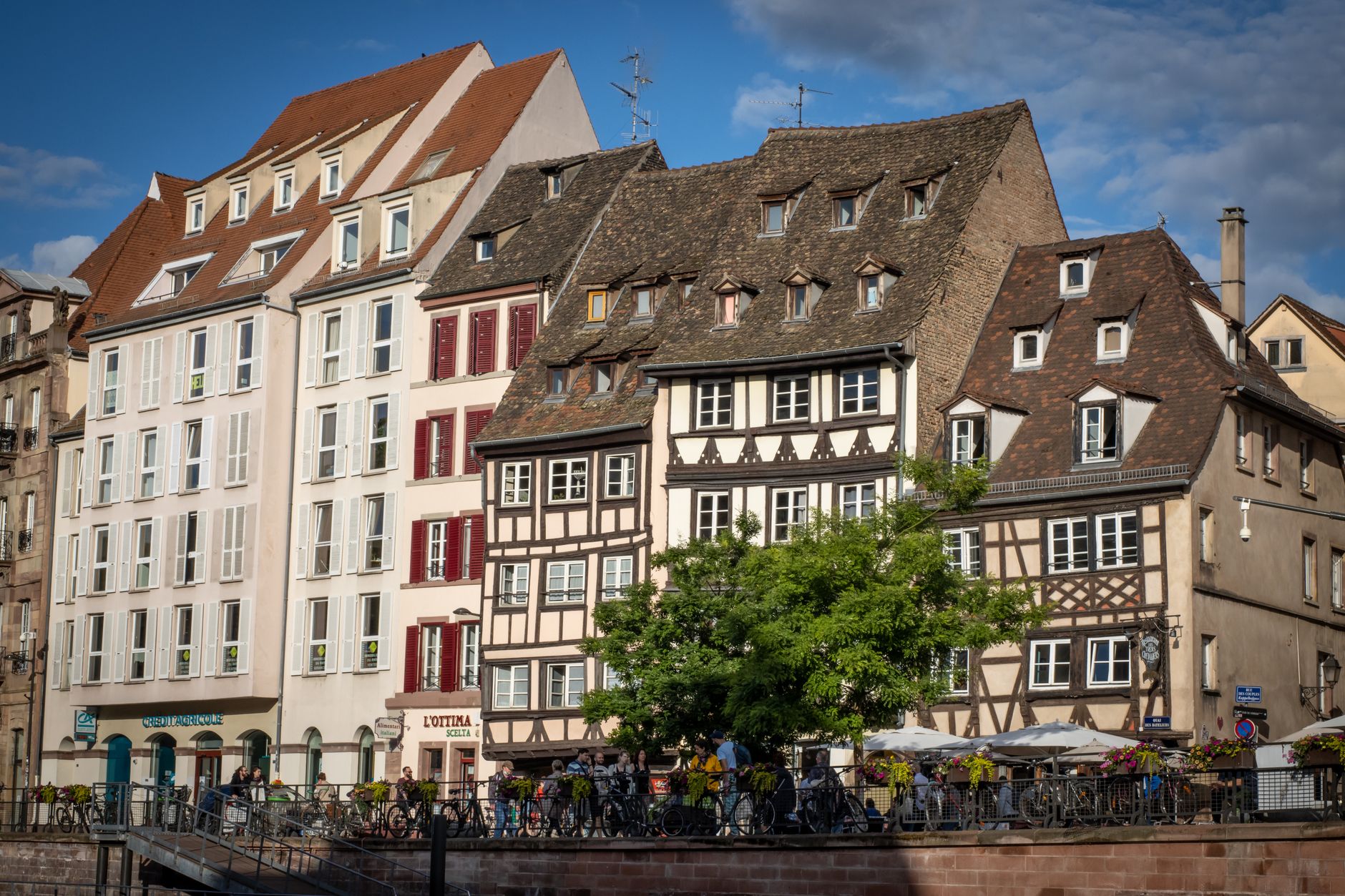
Every list of Alsace villages is the same list, in the same order, with the same photographs. This one is ordered differently: by whether you can actually get there and back in a day without a car, and by whether the place still has a life of its own once the coaches leave.
Some of them do. Some of them are, in August, an open-air shopping street with geraniums on it. We say which is which, because nobody else does, and because a bad village day out costs you an entire day of a short trip.
One clarification first, since the phrase gets used loosely. Les Plus Beaux Villages de France is a formal national association with an admissions process. In Alsace the members are Hunspach, Mittelbergheim, Bergheim, Hunawihr, Riquewihr and Eguisheim. Kaysersberg, Ribeauville, Obernai and Turckheim are not on that list, whatever the postcards say.
Riquewihr: the postcard, and the crowd it brings
An hour and a half to two hours door to door, for a village that only rewards the first hour of the morning, is the arithmetic that defeats most car-free visitors. The day out to Colmar, Riquewihr, Eguisheim and the Haut-Koenigsbourg puts the whole chain in one vehicle and gets you there early, with no connection to miss.
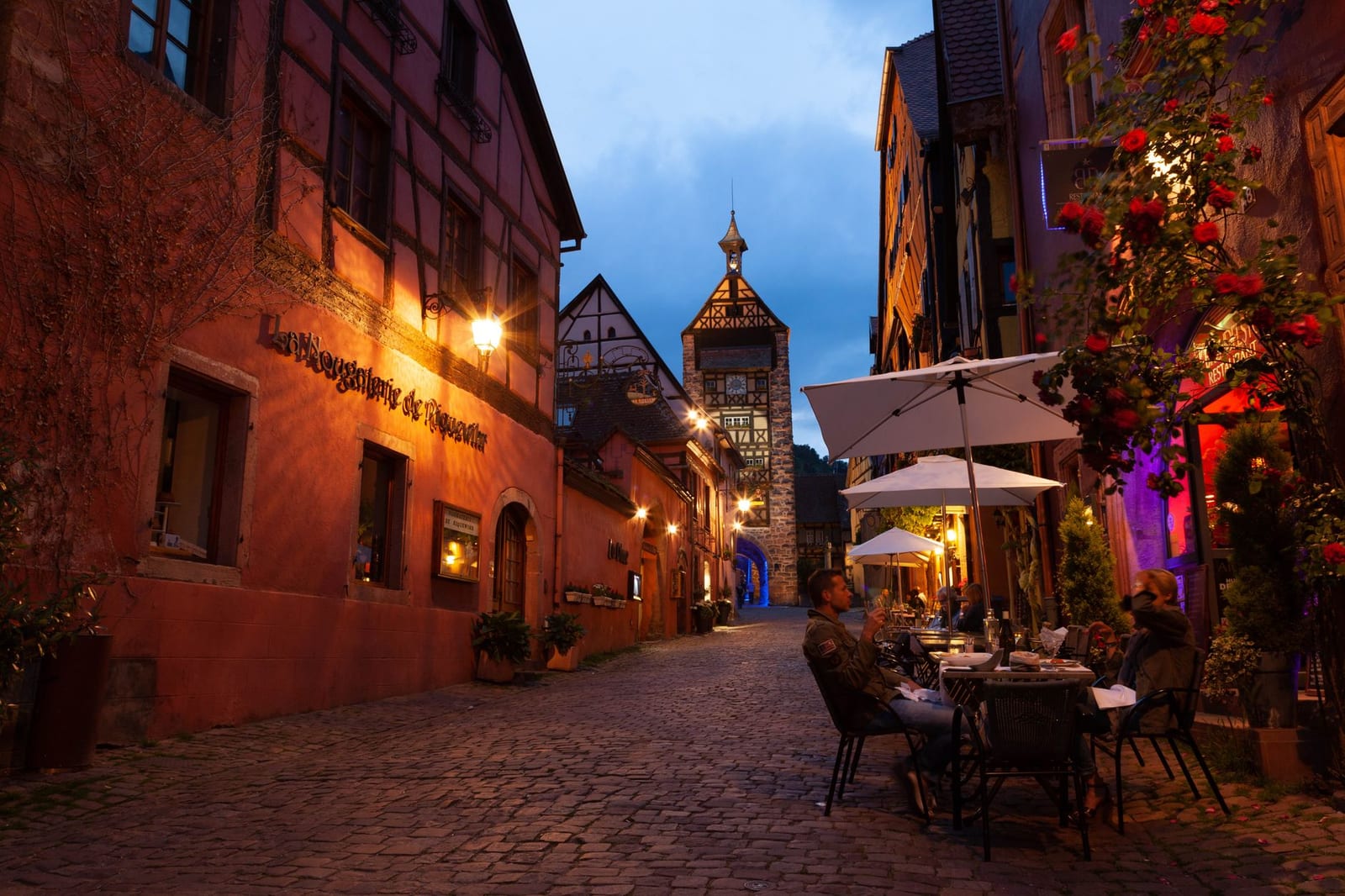
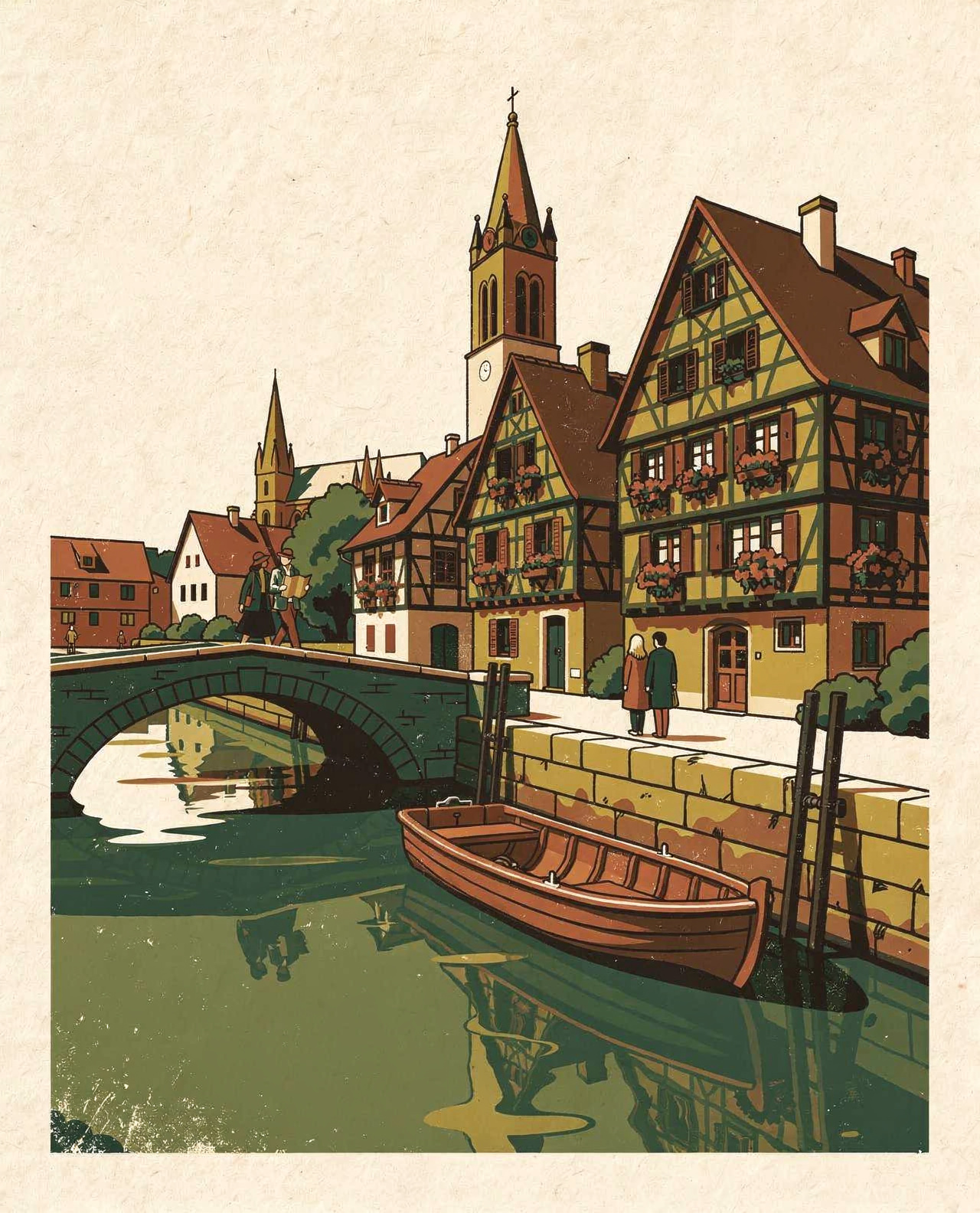
Riquewihr is the image most people carry of Alsace before they arrive: a fortified medieval village inside its walls, timbered facades in every colour, the Dolder gate tower closing the top of the main street, vines running right up to the ramparts.
It genuinely is beautiful, and it is also the most heavily visited village in the region. In August and through the Christmas market the central street is a solid line of souvenir shops and tour groups, and local life has largely retreated from the historic core.
Getting there: no station. The regional coach from Colmar via Riquewihr to Ribeauville is the reference service, taking a little over twenty minutes to reach the village from Colmar, but departures are limited and evening returns are early. From Strasbourg, budget an hour and a half to two hours door to door, train plus connection plus coach.
Time needed: two to three hours covers the main street, the ramparts and a short loop into the vines. A full day only if you continue on foot to the neighbouring villages.
Verdict: go, but go early, go outside July and August, and do not expect to be alone. Riquewihr rewards the first hour of the morning more than any other village on this page.
Eguisheim: the circular village that earns it
Eguisheim is built in concentric rings around the site of an old castle, which produces a street plan unlike anywhere else in the region: you walk in a spiral, and every turn opens another curve of painted facades. It was voted the country's favourite village in 2013 and it has never been quiet since.
What it keeps, and Riquewihr has largely lost, is a working wine village underneath the tourism. Growers still operate from the houses, the vineyard starts at the last row of buildings, and it does not feel like a set outside peak hours.
Getting there: no station. A short coach ride from Colmar, usually put at twenty to twenty-five minutes, though line numbers have changed between sources and the current timetable needs checking on the regional network before you travel. From Strasbourg, around an hour and a half door to door.
Time needed: two to three hours for the rings, the ramparts and the church, more if you walk out into the vines on the marked footpath.
Verdict: the best single village for a first visit, and the one where the walk out of the village is as good as the village. Weekends in summer are busy but not oppressive.
Kaysersberg: worth the awkward journey
Kaysersberg sits where a valley opens onto the plain, with a fortified bridge over the Weiss, a ruined castle on the hill above and a main street that still has butchers and bakers on it. It was voted the country's favourite village in 2017.
Of the three famous names it is the one that stays most recognisably inhabited outside high season, and it has the best walk: the climb to the castle takes twenty minutes and puts the whole valley below you.
Getting there: no station. The commune itself points visitors to the coach from Colmar station, quoted at around forty minutes including transfers and running roughly every three hours, which tells you everything about the planning required. Sunday service is not confirmed. From Strasbourg, allow up to two hours each way.
Time needed: three to four hours if you climb to the castle, which you should.
Verdict: the best of the three southern names, and the hardest to reach. If you have one village day and the timetable works, take this one. If it does not work, take Eguisheim without regret.
Ribeauville: the one that still has a town in it
Ribeauville is bigger and less pretty than Riquewihr, and better for it. It is a proper small town with shops that serve residents, a long main street under three ruined castles, and enough ordinary life that you are not permanently in a photograph.
Its moment is the medieval Christmas market, which is genuinely different from every other market in the region, and which runs for only two weekends, so it fills completely when it is on.
Getting there: no station, and this is the one people get wrong. Ribeauville's old railway line no longer carries passengers. Access is the same Colmar coach that serves Riquewihr, roughly half an hour, with a service that journey planners describe as hourly but which we could not confirm from the operator's timetable for 2026.
Time needed: three to four hours for the centre and the collegiate church, longer if you walk up towards the castles.
Verdict: the sensible half of a Riquewihr day. Do the postcard village in the morning, come here for lunch and the afternoon, and you get both the picture and the reality.
Obernai: the easy one, and not a village
Obernai is the answer for anyone based in Strasbourg who wants vineyard Alsace without spending three hours on transport. It is a small town rather than a village: ramparts, a handsome market square, a working commercial centre and vines starting just outside.
Getting there: this is its whole case. Direct regional trains from Strasbourg run from before five in the morning until after half past ten at night, with dozens of services a day, the fastest under half an hour, and fares starting from €4 on the cheapest tickets. The station is a ten to fifteen minute walk from the centre.
Time needed: half a day to a full day, depending on whether you walk out into the vineyard.
Verdict: the most reliable vineyard day from Strasbourg by a distance, and the one to choose if the weather is uncertain or you are travelling with people who will not tolerate a two-hour bus plan. It is oversold as a village and undersold as a day out.
Colmar: a town, and the base you probably need
Our own answer is that you probably do not need to move. The villages are day trips whichever end you start from, and keeping one address in Strasbourg spares you a second check-in and a second set of bags. This Renaissance inn is the version for people who came to Alsace for exactly this kind of building.
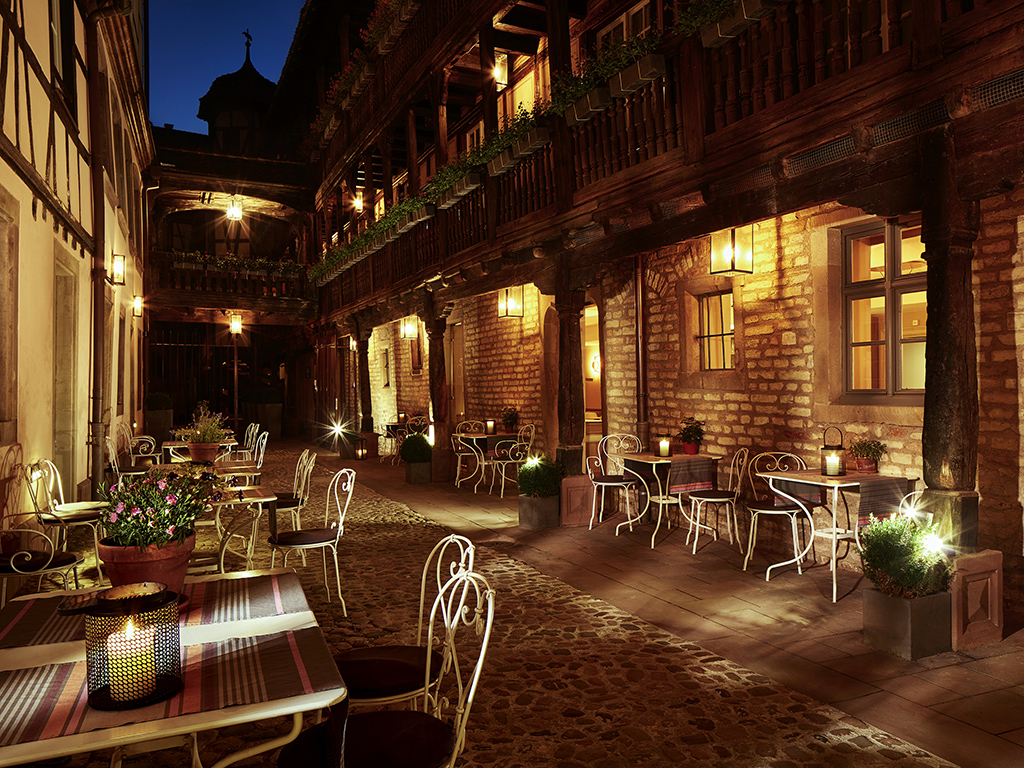
Cour du Corbeau★ 4,8 · 1,311 reviews
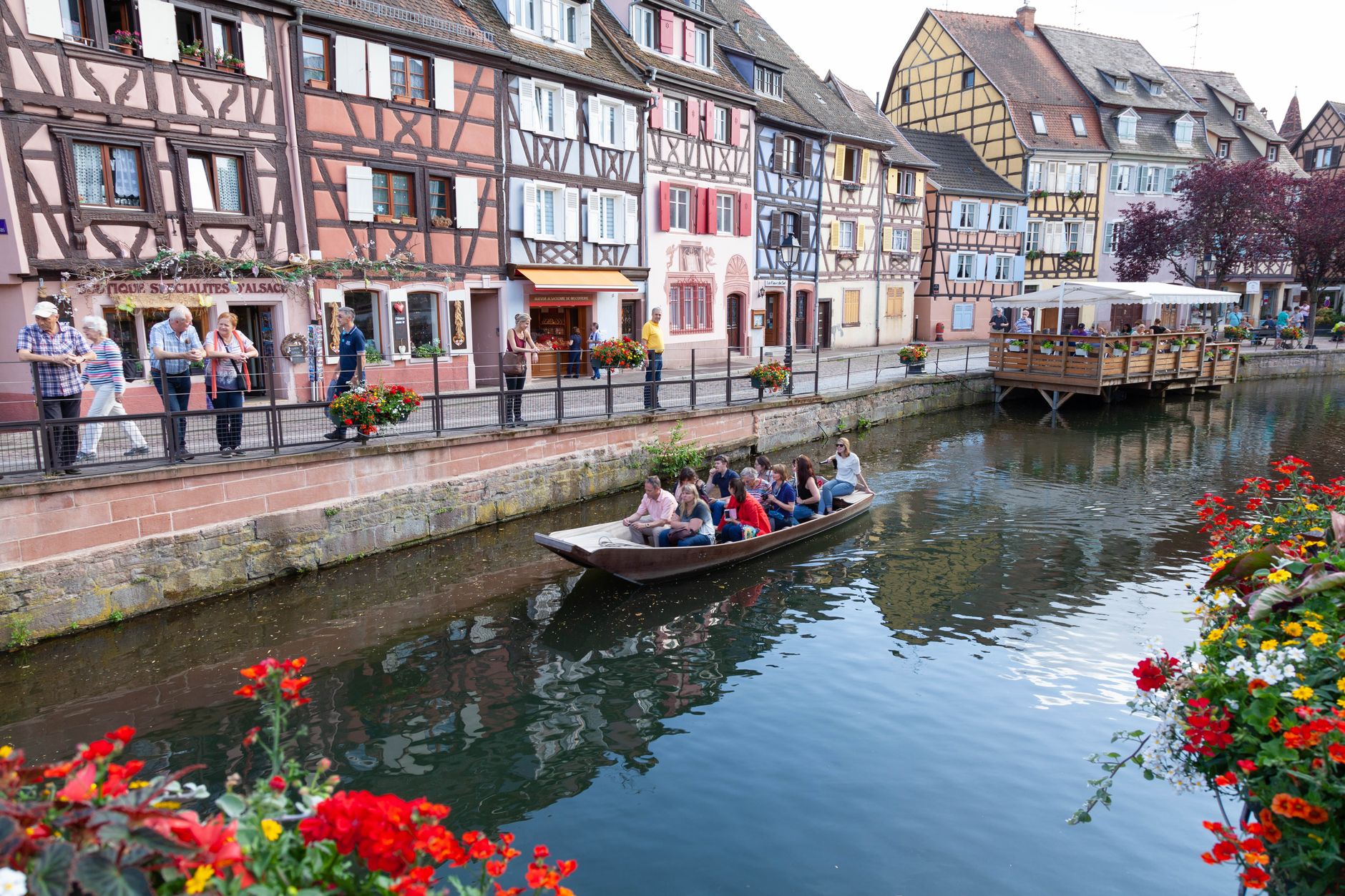
Colmar is not a village and does not pretend to be, but it is where any car-free village plan begins, and it deserves a straight assessment of its own. Trains from Strasbourg take 26 to 35 minutes and run every 30 minutes through the day.
Here is the honest ranking of what is there. Overrated: the Petite Venise, which is a short and very crowded stretch of canal that the tourist office presents as a half-day and which is closer to twenty minutes. Genuinely worth the trip: the Unterlinden museum and the Issenheim altarpiece, which is one of the major works of European painting and justifies the journey on its own.
The museum costs €14 at full price and closes on Tuesdays, so a Tuesday day trip removes the best reason to come. The Bartholdi museum, in the birthplace of the sculptor of the Statue of Liberty, costs €5 and closes on Mondays and for the whole of January.
Colmar has no tram. Everything is done on foot from the station, which is fine, because the town is small.
The quieter five, which are the point
Hunawihr is a small wine village between Riquewihr and Ribeauville, on the national list of most beautiful villages, with a fortified church on a rise above the vines. One to two hours is enough, and the reason to come is that it is calm. It has no bus of its own worth planning around: you arrive on foot from Riquewihr.
Bergheim is a walled village that joined the national list in 2022 and was voted the country's favourite that same year. It is quieter than the famous three outside December and it has genuine ramparts to walk. Two to three hours, reached by coach from Colmar or Selestat.
Mittelbergheim has held the label since 1986 and is the northern equivalent of Hunawihr: small, sober, still a working wine village, almost no coaches. Reachable from Strasbourg via the Barr or Obernai line plus a short local connection, which is not always straightforward.
Turckheim is the exception that proves the rule, because it does have a station, on the branch line from Colmar into the Munster valley, with the platform only a few minutes from the main square. Two to three hours for the gates, the ramparts and a vineyard footpath.
Dambach-la-Ville is a fortified wine town on the main Strasbourg to Selestat corridor with its own station, and it is the least sold and least crowded of the lot. Two to three hours, and you will not queue for anything.
Walking between them, which is the real answer
The best way to see several villages without a car is not to catch three buses. It is to catch one, and walk.
The intercommunal vineyard trail known as Les Perles du Vignoble links Beblenheim, Bennwihr, Hunawihr, Mittelwihr, Riquewihr and Zellenberg. The commune of Hunawihr describes the full circuit as a 17 km loop, about 10.5 miles, walkable or rideable in either direction and open all year without booking.
You do not have to do all of it. Shorter marked sections between Riquewihr, Hunawihr and Zellenberg run to three or four kilometres each, an hour to two hours, over rolling vineyard slopes rather than anything steep.
The practical version: take the morning coach to Riquewihr, walk to Hunawihr, continue towards Zellenberg or drop down to Ribeauville, and pick up the coach back to Colmar from there. That is one bus out, one bus back, three villages, and no timetable anxiety in the middle of the day.
Eguisheim and Turckheim both have their own marked vineyard loops of a comparable scale, though we could not find an official current distance for the Eguisheim circuit and are not going to guess one.
What actually fits into one day
The last line of that list deserves a footnote. Three southern villages in a day is impossible on public transport and routine in a minibus, which is the whole of the difference: a guided day along the wine route is the realistic way to chain them if you are not driving.
Based in Colmar, without a car, three plans work:
- Riquewihr and Ribeauville on the same coach line, two to three hours in each, returning before the evening service thins out.
- Eguisheim plus a vineyard walk, a short ride out and a full unhurried day.
- Kaysersberg alone, given a service running roughly every three hours, with the castle climb to fill the afternoon.
Based in Strasbourg, you are adding at least an hour of train each way, so the list shortens:
- Obernai, easily, with time to spare.
- Dambach-la-Ville or Barr, easily, and almost nobody does it.
- Colmar plus one southern village, feasible but tight, and only worth it if the bus times line up.
- Three southern villages in a day. No. Not on public transport, whatever a tour operator's itinerary implies.
Between April and October the seasonal shuttle changes this arithmetic, and it is the one tool that makes a multi-village day realistic. We cover it, along with cellar visits and the grapes themselves, in the Alsace Wine Route guide.
In December the villages run their own Christmas markets and a weekend shuttle from Colmar, which is a different calculation again: see the Christmas section. And when you get there and sit down, Alsatian food explains what is on the menu.
Frequently asked questions
Which Alsace villages hold the Plus Beaux Villages de France label?
Which Alsace village is the best one to visit?
Can I visit Riquewihr and Eguisheim in one day without a car?
Is Riquewihr too touristy?
Which Alsace village is easiest to reach from Strasbourg?

Théo Lindner
Théo grew up between Strasbourg and the Vosges. He walks every route before publishing it, times every leg, and would rather cut a stop than pretend a day is longer than it is.